An Essential Guide to Epoxy vs Polyaspartic


Blast Off: An Introduction to Concrete Coatings
Epoxy vs Polyaspartic is a common question when choosing a concrete floor coating. While epoxy has been a traditional choice, polyaspartic is a newer technology that solves many of its shortcomings. Here’s a quick comparison:
| Feature | Epoxy | Polyaspartic |
|---|---|---|
| Cure Time | 2-5 days | 4-6 hours (same-day install) |
| UV Resistance | Poor (yellows over time) | Excellent (no yellowing) |
| Flexibility | Rigid (prone to cracking) | 98-100% more flexible |
| Temperature Range | 50-85°F only | -40°F to 140°F |
| Durability | Moderate | 4x stronger than low-end epoxy |
| Lifespan | 3-7 years (may need recoating) | 10-20+ years |
The differences are clear. Polyaspartic coatings are approximately four times stronger and 98-100% more flexible than epoxy, preventing cracks from concrete’s natural movement. They cure in just 4-6 hours, allowing for one-day installation, and can be applied in a wide range of temperatures (-40°F to 140°F).
Crucially, polyaspartic offers 100% UV stability, so it won’t yellow or fade in sunlight like epoxy. This makes it ideal for patios, driveways, and garages with windows.
As Hayley Shahbazi, Manager at Galaxy Concrete Coatings, I’ve seen how polyaspartic technology delivers superior results. Our expertise has made us the nation’s top installer of Penntek coatings, changing spaces across Arizona, Colorado, Indiana, and Ohio. Let’s explore why polyaspartic is the gold standard.
The Great Debate: A Deep Dive into Epoxy vs Polyaspartic
When you’re standing in your garage or looking at your worn patio, choosing between concrete coatings can feel overwhelming. Let’s break down Epoxy vs Polyaspartic across the factors that truly matter—from the chemistry that makes them work to how they’ll look and perform years down the road.
Chemical Composition and Bonding: The Science Behind the Shine
Understanding the science behind these coatings reveals why they perform so differently. Epoxy is a two-part system (resin and hardener) that cures into a rigid, plastic-like surface. It primarily creates a topical bond, sitting on top of the concrete.
Polyaspartic coatings, built on advanced aliphatic polyurea technology, take a different approach. They penetrate into the porous structure of the concrete, creating a deep mechanical bond that integrates with the slab itself. Think of it as dyeing a fabric versus placing a sticker on it—one becomes part of the material, while the other just sits on the surface. This superior bond gives polyaspartic its exceptional resilience.
Regardless of the coating, proper surface preparation is absolutely essential. Grinding the concrete is non-negotiable to create the profile needed for a lasting bond. Without it, any coating system will fail. You can learn more on our page about The Science Behind Durable Concrete Coatings.
As Mark S. shared about his experience with us: “The entire process was seamless. From the initial quote to the final walkthrough, the team was professional and communicative. Our garage floor has been transformed and the quality is top-notch. It’s held up perfectly to everything we’ve thrown at it. Worth every penny!”
Durability and Longevity: Which Coating Wins the Space Race?
When protecting your concrete, durability is everything. In the Epoxy vs Polyaspartic battle, the performance gap is significant.
Polyaspartic coatings are approximately four times stronger than low-end epoxy, offering superior resistance to abrasions, scratches, and impacts. Where rigid epoxy can chip or crack under stress, polyaspartic’s standout quality is its remarkable flexibility—98-100% more than epoxy.
This elasticity allows the coating to move with your concrete as it expands and contracts with temperature changes, preventing the cracks and delamination that plague brittle epoxy. It’s also why our polyaspartic coatings are exceptionally resistant to hot tire pickup, a common failure point for lesser coatings.
Furthermore, polyaspartic creates a 100% seamless and non-porous water-resistant floor seal, protecting your concrete from moisture damage. A professionally applied polyaspartic floor is engineered to last 10-20+ years, providing an impact-resistant shield that stands the test of time. Learn more on our Impact Resistant Floor Coatings page.

Application and Curing: The Countdown to a Flawless Floor
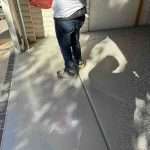
The application process highlights a dramatic difference between Epoxy vs Polyaspartic. Epoxy often requires several days to cure, creating significant downtime. In contrast, polyaspartic coatings cure in just 4-6 hours, allowing our teams to complete a one-day floor installation. You can walk on it in about 5 hours and return to vehicle traffic in as little as 24-96 hours. Learn more about this rapid process on our One Day Floor Installation page.
Polyaspartic also excels in various climates. While epoxy requires a narrow temperature window (50-90°F), our coatings can be applied from -40°F to 140°F, making year-round installation possible.
Though DIY epoxy kits are available, their sensitivity to conditions often leads to failure. Polyaspartic’s rapid cure time requires professional expertise, which is why we always recommend professional installation to guarantee a flawless, long-lasting finish.
As John D. shared: “Galaxy did an amazing job on our garage floor. The crew was professional, courteous, and efficient. The floor looks fantastic and is so easy to clean. We are extremely happy with the result and would highly recommend Galaxy to anyone looking for a high-quality garage floor coating.”

Aesthetics and Maintenance: A Universe of Style and Simplicity
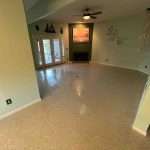
A floor should look great for years, and this is where polyaspartic truly shines. Its most significant advantage is 100% UV stability. Epoxy yellows and fades in sunlight, making it a poor choice for patios or even garages with windows. Our polyaspartic coatings maintain their vibrant, high-gloss finish for decades without discoloration.
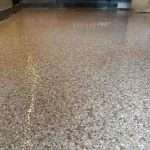
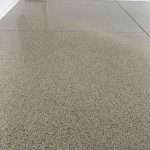
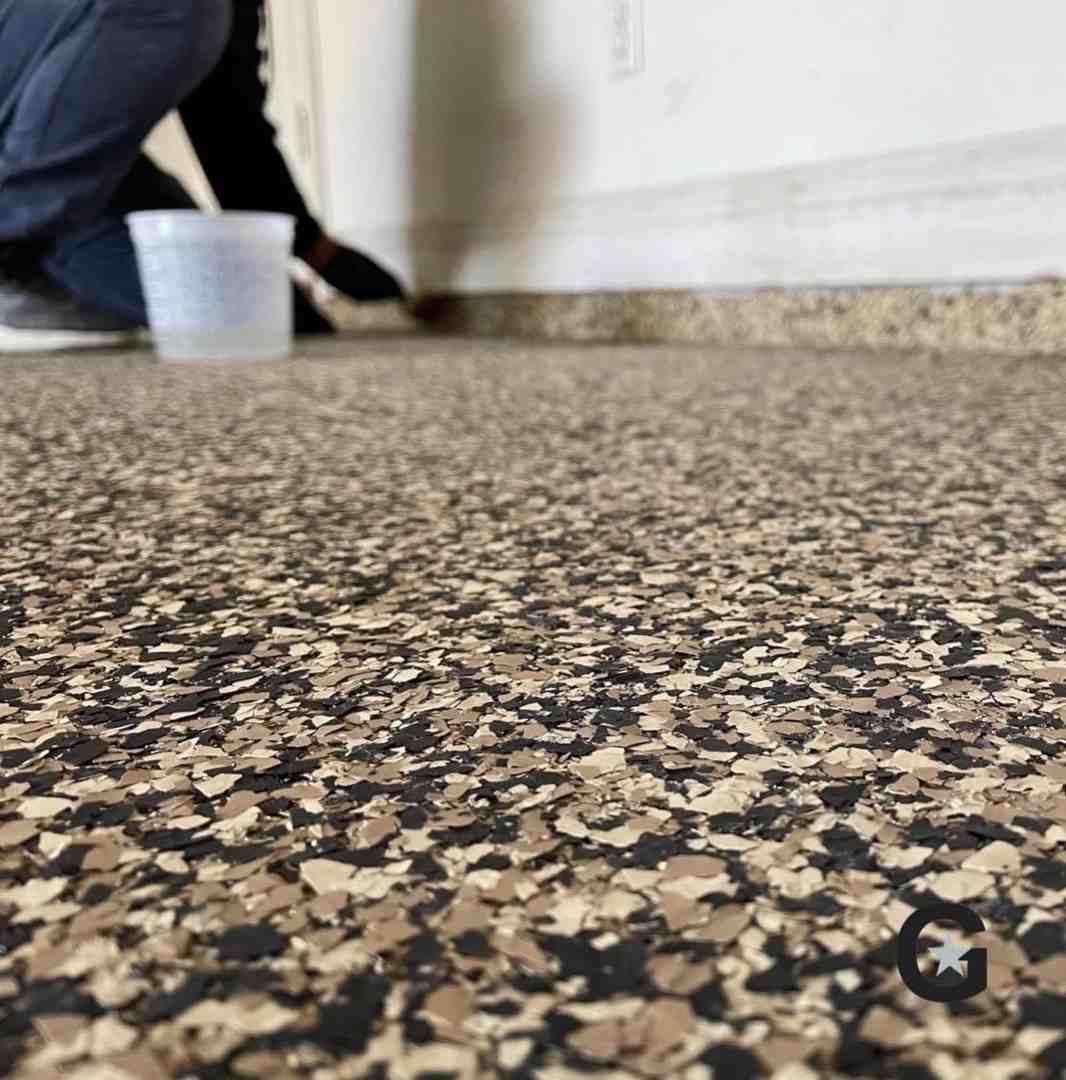
Both coatings offer customization, but our Concrete Coating Types: Flake System provides a universe of colors and textures. These decorative flakes not only look beautiful but also add traction and hide minor imperfections.
For maintenance, polyaspartic’s seamless, non-porous surface makes cleaning simple. Its superior chemical resistance means tough spills like oil and brake fluid can be cleaned easily without staining, a common issue with epoxy.

The Bottom Line on Epoxy vs Polyaspartic: Cost and Environmental Impact
When considering Epoxy vs Polyaspartic, it’s important to look beyond the initial price tag. Epoxy materials are often cheaper upfront, but this can be misleading. Its shorter lifespan and susceptibility to damage often lead to costly repairs and reapplications.
Polyaspartic has a higher initial material cost but represents a smarter long-term investment. Its superior durability and longevity mean you get a floor that lasts for decades with minimal maintenance, providing far greater value over time. You can learn more on our Polyaspartic Floor Coatings Cost page.
We are also committed to safety and environmental health. Our professional-grade polyaspartic systems are formulated with low to ultra-low volatile organic compounds (VOCs), resulting in less odor and better indoor air quality compared to many cheaper coatings.
The Verdict: Why Polyaspartic is the Star of the Show
After exploring the Epoxy vs Polyaspartic debate, the winner is clear: polyaspartic coatings are the shining star in the galaxy of concrete solutions.
Polyaspartic outperforms epoxy in nearly every metric that matters to homeowners and businesses. It’s four times stronger, 98-100% more flexible, cures in hours, and is 100% UV stable—it will never yellow. For garages, patios, and commercial spaces, it provides a durable, beautiful finish with minimal downtime.
This is a long-term investment that protects your concrete for 10-20+ years. However, professional installation is essential to achieve these results, as the material requires specialized application techniques. We’re proud to be the nation’s top installer of Penntek coatings, reflecting our commitment to excellence.
As Linda L. from Denver, CO, shared: “We had our garage floor done by Galaxy and it is beautiful! The crew was very professional and did a great job. We are very happy with the results and would highly recommend them.”
Ready to launch your concrete into a new era of durability? Learn more about our Polyaspartic vs Epoxy Floor Coatings. Our customers’ five-star ratings prove our work shines as brightly as the stars.
- Arizona
- Colorado
- Indiana
- Ohio